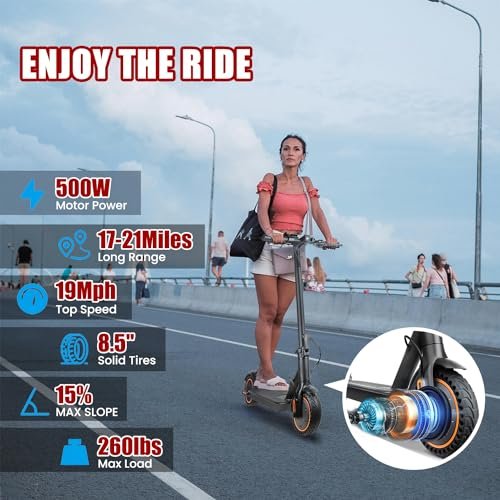
Widoway's 8.5-inch solid honeycomb tires contain no air to lose — no punctures, no inflation routine, and no deflated tire waiting for you on a Tuesday morning.
The high-carbon steel frame is rated to 264 lbs — well above the 220-lb ceiling that most entry-level scooters quietly set, with manufacturer testing confirming 15 mph at 220 lbs on flat terrain.
The 500W model ships restricted to 15–16 mph by default; downloading the KCQ app and scanning the QR code on the display unlocks the full 19 mph top speed — no tools, no modifications required.
Widoway covers the scooter unit for 12 months and parts for 180 days from receipt, with a 30-day return window for quality issues and an E1–E9 error code system displayed on the LCD for faster support diagnosis.
Every Widoway scooter is built on the same DY8501 platform — same solid tires, same 3-second fold, same 264-lb frame — with the motor tier as the one decision that changes based on your commute distance and terrain. Here's how the three listings break down.
This listing covers both motor tiers in one place — the 350W variant runs 16 mph with a 12-mile range on a 36V/5.2Ah battery, ideal for flat daily routes under 6 miles round-trip. It also carries the clearest warranty language of any Widoway listing: 12-month scooter coverage and 180-day parts, explicitly stated.
Best entry point for flat-terrain commuters who want the full Widoway platform — solid tires, app connectivity, 264-lb capacity — without paying for hill-climbing power they won't use.
See on Amazon
The flagship 500W listing is the one to choose if your commute involves hills, longer distances, or a heavier rider. Manufacturer testing puts it at 17 mph and 16–18 miles at 165 lbs; 15 mph and 14–16 miles at 220 lbs. UL2272 certified, available in three colors, and backed by 668 reviews at 4.3 stars — the highest-confidence Widoway listing on Amazon.
The right call for any commute with inclines, distances above 5 miles each way, or riders who want the full 19 mph unlocked through the KCQ app.
See on Amazon
An alternate DY8501 listing with an aluminum frame instead of carbon steel and a slightly taller folded profile at 47 inches versus 44. The platform specs are otherwise identical — same tires, same braking, same 264-lb capacity. Note that this listing carries only 14 reviews at 3.7 stars and shows limited remaining inventory.
Worth considering only if you specifically want the aluminum-frame build — for buyer confidence, the B0DFYZRV8F listing with 668 verified reviews is the stronger choice at the same motor tier.
See on AmazonThe right Widoway depends on three things: how far you're riding, whether your route has hills, and how much the scooter will weigh when you're carrying it up stairs. Get those three numbers right and the choice between the 350W and 500W basically makes itself.
The 350W Commuter is the call. A 5-mile round trip on flat pavement uses roughly 40% of the 350W's 12-mile charge — which means you can do back-to-back days before plugging in. The motor handles smooth streets and mild grades without strain, and the platform is identical to the 500W in every way that matters for a short urban commute: same 26-pound frame, same 3-second fold, same 264-lb capacity, same KCQ app. You're not giving up much. You're paying for exactly what your commute needs.
Get the 500W. Here's why the math matters: the 350W tops out at 12 miles under ideal conditions, which means a 6-mile round trip leaves almost no buffer for real-world variables — a heavier load day, a detour, or cold weather cutting battery output by 15–20%. The 500W's 17–21 mile range gives you genuine room to breathe. And on grades up to 15%, the 500W maintains power where the 350W would start laboring.
Both models carry up to 264 lbs — that's the frame spec, and it holds across the lineup. But rider weight affects performance differently at each motor tier. At 220 lbs, the manufacturer's own road tests show the 500W hitting 15 mph and covering 14–16 miles. On the 350W at the same weight, expect the 12-mile ceiling to shrink further. If your daily round trip is 4+ miles and you're above 180 lbs, the 500W is the safer choice for consistent performance.
Either model works, but there's a practical reason to start with the 350W if your commute fits within its range: it ships in a default speed mode that keeps things manageable while you build confidence. The 500W also ships speed-restricted by default (15–16 mph out of the box), so you're not getting dumped into 19 mph on day one regardless of which you choose. The KCQ app unlocks the full speed range on the 500W once you're ready — it's not locked forever, just until you decide to change it.
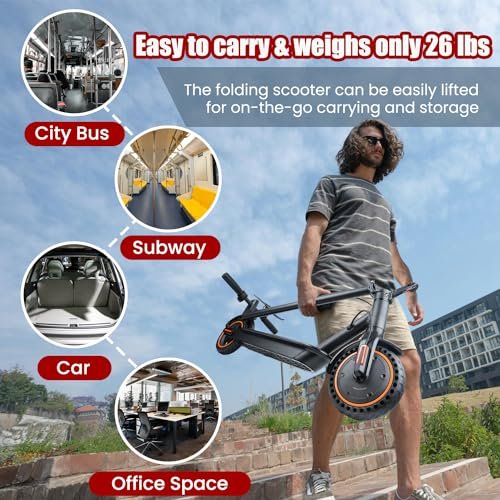
Both weigh 26 pounds. That's not nothing — 26 pounds is a carry, not a feather. But it folds to a compact shape that tucks under a seat on a subway car or stands against a wall in a hallway. The fold takes about 3 seconds with one lever and a click. For a hybrid commute — scooter to train, train to office — that speed matters. You're not wrestling with it at the station entrance.
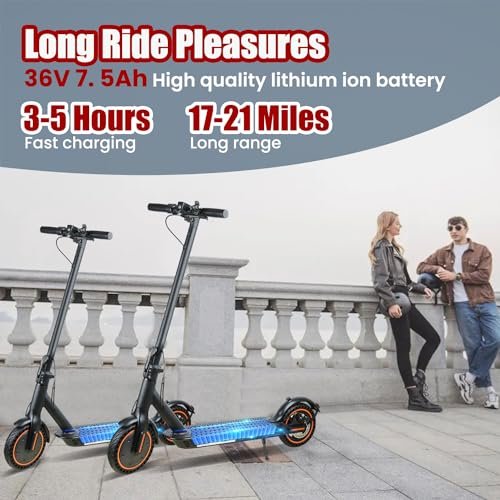
The 500W Widoway lists a range of 17–21 miles. That ceiling is real — but it requires a 110-lb rider on flat pavement at moderate speed in mild weather. Most adult commuters in American cities will see 14–18 miles. Here's what actually moves that number, and how to plan around it.
The manufacturer ran flat-road city tests and published the results directly in the product listing. These are the most honest numbers to work from:
Those test results are flat road, no hills, optimal temperature. They're a ceiling at each weight bracket, not a guarantee. The practical planning range for most riders — 150 to 200 lbs, mixed city terrain, some stop-and-start — sits around 14–17 miles on the 500W. Plan your commute around 14 miles and you'll never be unpleasantly surprised.
Rider weight. The single biggest variable. Every 50 lbs above the test baseline shaves roughly 2–4 miles off the listed range. A 200-lb rider on the 500W should expect closer to 15 miles than 21.
Hills. A 15% grade pulls significantly more current from the battery than flat ground. One steep hill per mile of commute can reduce total range by 20–25% compared to flat-road figures. The 500W handles those grades — it doesn't do it for free.
Speed. Riding at 19 mph burns through charge faster than cruising at 14 mph. If range is a concern on your commute, the middle speed mode gives you a better balance of pace and distance than full throttle.
Cold weather. Lithium-ion batteries lose 15–20% of their output below 45°F. Chicago riders, New York riders, anyone in a northern city — your January range is meaningfully shorter than your September range on the same route. Factor that in before winter.
Stop-start acceleration. Hard acceleration from a dead stop draws the most current of any riding behavior. City riding with frequent traffic lights and intersections costs more range than a steady open-road cruise at the same average speed.
The 350W model lists 12 miles — but that's under the same ideal conditions. Real-world range for a 165-lb rider on city streets with normal stop-start riding is closer to 9–11 miles. That's still enough for a 4-mile round trip with buffer, but it's not a commute you can double-run without charging. Plug in every night, and the 350W covers most short urban use cases without drama.
Widoway's own instructions ask you to fully charge the battery before your first ride. Do that. After that, partial charges are fine — modern lithium-ion cells don't carry the memory problems that older battery types did. What does reduce long-term capacity is repeatedly draining to zero. If you're down to one bar, charge it. And keep the charging port dry: the listing specifically warns against water at the port, which can damage the battery even in light rain if the cover isn't secured.
At roughly 300–500 full charge cycles — about 1 to 1.5 years of daily use — most lithium packs start showing measurable capacity reduction. That's not a defect, it's chemistry. By that point you'll likely notice a shorter real-world range before you'd notice any other performance change.
The 500W Widoway ships restricted to 15–16 mph by default. This surprises a lot of first-time buyers who read "19 mph" in the listing and expect to hit that number on the first ride. The restriction is intentional, it's removable, and it takes about two minutes to change via the KCQ app.
Most markets and platforms that sell consumer electric scooters require manufacturers to cap default speeds at or below 15–16 mph for safety and compliance reasons. The DY8501 is designed to operate up to 19 mph, but it leaves the factory in a restricted mode that keeps it legal and manageable for riders who haven't adjusted their settings. This isn't a hardware limitation — the motor is fully capable of the listed speed. It's a software setting.
The process runs through the KCQ app:
After that, the 500W motor runs up to its full 19 mph ceiling. The app retains the setting — you don't need to re-enter it every ride.
Mode 1 (Eco / Low): Capped at roughly 10–12 mph. Draws the least current, extends range the most. Good for congested paths, campus sidewalks, or any situation where you want to keep things slow and predictable.
Mode 2 (Standard): Mid-range speed, the default shipped setting. Works well for most city commutes — fast enough to be useful, slow enough to stop safely in traffic.
Mode 3 (Sport): Full speed unlock. This is where the 500W motor reaches its 19 mph ceiling, assuming rider weight and terrain allow it. Range decreases at this mode compared to Eco.
You can switch between modes from the app or, on most DY8501 firmware versions, by pressing the power button twice while riding.
Honestly — anyone new to electric scooters. The default 15–16 mph is not slow. At that speed you need at least 15–20 feet of stopping distance on dry pavement, and city riding introduces pedestrians, parked cars, and intersections constantly. Spend a few weeks at the default setting before unlocking Sport mode. The motor isn't going anywhere.
Also: some local regulations cap ridden scooter speeds on public paths. Check your city's ordinances before riding in Sport mode on shared pedestrian paths. The restriction feature exists partly for this reason — you can always re-enable it from the app if your commute route requires it.
Both the 500W Flagship and the 350W Sport listing carry UL2272 certification. For buyers who've spent time in electric scooter forums and seen the warnings about cheap Amazon scooters catching fire, that certification is worth understanding — not as marketing language, but as a specific standard with defined requirements.
UL2272 is a safety standard developed by Underwriters Laboratories specifically for self-balancing scooters and personal electric mobility devices. It covers electrical system safety — battery management, charger design, wiring integrity, and protection against overcharge, overdischarge, and short circuit conditions. The standard was introduced after a wave of lithium battery fires in cheap hoverboards around 2015–2016, and it's since been applied broadly to the electric scooter category.
A scooter carrying UL2272 certification has been tested against a defined set of electrical safety criteria by an independent lab. The battery pack, charger, and electrical system passed those tests. That's a meaningful bar — not every scooter in this price tier clears it.
It's worth being direct about the scope. UL2272 is an electrical safety standard, not a structural or durability standard. It doesn't certify how long the frame will last, how well the brakes perform, or whether the motor will hold up after 500 charge cycles. It also doesn't address water resistance — the DY8501 is not rated for rain, regardless of UL2272 status.
The certification is meaningful for battery safety specifically. It answers the question "is this going to catch fire in my apartment?" more reliably than the absence of any certification does. For structural and mechanical concerns, the 12-month warranty and the community review record (4.3/5 across 1,173 verified reviews on the two primary listings) carry more weight than any single lab certification.
The r/ElectricScooters community's default position on budget Amazon scooters is cautious — and reasonably so. There are cheap scooters in this category with no safety certification, untested battery management systems, and no warranty path when something goes wrong. The UL2272 mark doesn't make the Widoway a premium product. But it does mean the battery system passed a third-party electrical safety review, which is a real distinction from the bottom of the category.
Pair that with the 12-month scooter warranty and the E1–E9 error code display system — which actively helps you diagnose problems rather than leaving you guessing — and the support infrastructure is meaningfully better than what you'd find on an uncertified budget alternative.
Widoway covers the scooter unit for 12 months and replacement parts for 180 days from the date of receipt. Returns and exchanges for quality problems are accepted within 30 days. That's the full picture — and it's above-average coverage for this price tier.
12-month scooter coverage: If the scooter develops a quality defect within the first year — motor failure, braking system fault, battery malfunction — that falls under the scooter warranty. Contact Widoway support through the Amazon store and document the issue. The error code display (more on that below) helps support staff diagnose the problem before you ship anything back.
180-day parts warranty: Replacement components — charger, display, brake components — are covered for the first 180 days. This is the more commonly activated tier for lower-severity issues.
30-day return/exchange: If you receive a scooter with a quality defect out of the box, or discover an issue early on, you have 30 days to return or exchange it for a quality problem. This is the cleanest resolution path if something's clearly wrong on arrival.
The warranty documentation ships with the unit. Keep it. The manual also contains additional detail that the Amazon listing summarizes but doesn't fully reproduce.
The DY8501's LCD display shows diagnostic error codes when a fault is detected. This is genuinely useful for support conversations — rather than describing "the scooter just stopped working," you can tell support exactly what code appeared. Here's the full list from the product documentation:
E5 is the most common early-rider error — it fires when a new scooter hasn't been fully charged before first use. Widoway's instructions explicitly ask you to fully charge the battery before riding for the first time. If E5 appears on an otherwise new scooter, charge it fully and try again before contacting support.
Support runs through the Amazon store. Go to the Widoway Store on Amazon (amazon.com/stores/WidowayEscooter), or use the "Contact Seller" option on your order. Widoway lists 24-hour customer support availability in their product copy. When you reach out, have your order number and the error code (if applicable) ready — it speeds up diagnosis considerably.
No direct website, phone number, or standalone email is listed in the available brand documentation. Amazon messaging is the documented support path for this brand.
Across 1,173 verified reviews on the two primary Widoway listings (both rated 4.3/5 stars), the most commonly flagged early issues involve the speed restriction surprise — not a warranty issue, just a settings question — and range calibration against expectations. Actual mechanical failures show up in the minority of reviews. That's consistent with the category, but it's also worth noting: at this price tier, the 12-month warranty is your safety net for the cases where something does go wrong. Use it if you need it.
We embedded this one because the reviewer bought a budget electric scooter out of pocket — no sponsorship, no free unit — and rode it to find out whether the price point holds up in real use. That's exactly the question our customers ask us, and an independent answer carries more weight than anything we say ourselves. You'll see what a sub-$200 scooter actually looks like in practice, which helps you calibrate what you're getting when you step up to a Widoway. Watch it, then come back and we'll tell you exactly where the difference shows up.
All three Widoway listings share the same DY8501 platform, but the differences between motor tiers matter more than they might look at first glance. Use this table to match the right configuration to your actual route, weight, and daily distance.
| Feature | 500W Flagship Scooter | 350W/500W Commuter Scooter | 350W Sport Scooter (Aluminum) |
|---|---|---|---|
| Motor | 500W | 350W or 500W (choose at purchase) | 350W or 500W (choose at purchase) |
| Top Speed (default / unlocked) | 15–16 mph / 19 mph | 16 mph (350W) / 19 mph (500W) | 15–16 mph / 19 mph |
| Range (ideal conditions) | 17–21 miles | 12 miles (350W) / 21 miles (500W) | 17–21 miles |
| Weight Capacity | 264 lbs | 264 lbs | 264 lbs |
| Frame Material | High-carbon steel | High-carbon steel | Aluminum |
| Scooter Weight | 26 lbs | 26 lbs | 26 lbs |
| Charge Time | 5 hours | Not specified | 5 hours |
| Verified Reviews | 668 at 4.3 stars | 505 at 4.3 stars | 14 at 3.7 stars |
If your commute is under 5 miles round-trip on flat terrain and hills aren't a factor, the 350W variant on the Commuter listing does the job cleanly — and it ships with the clearest warranty documentation of the three. Step up to the 500W Flagship if your route includes any grade, your round-trip exceeds 6 miles, or you're a heavier rider who wants the motor's performance headroom at 220 lbs. The Aluminum Sport listing is worth considering only if you specifically prefer that frame material — the review count is too low to draw meaningful reliability conclusions.
"Bought the 500W to replace my Lime rental habit on the back half of my commute. The fold genuinely works — one lever, three seconds, and it tucks under my desk at the office. Battery gets me 4 miles each way without sweating the charge. The solid tires feel a little stiff on the brick stretch near my station, but I haven't touched an air pump in four months."— Marcus T., City commuter using transit for the first leg
"First scooter I've ever bought and I almost talked myself out of it about ten times. Assembly took maybe 15 minutes with the included tools — genuinely no drama. The app connected first try. Range is about 14 miles in my real experience, not 21, but my office is only 3 miles away so it doesn't matter. Feels solid, not cheap."— Jennifer R., First-time electric scooter owner
"Lives in my apartment closet, rolls out in the morning, folds back up when I get to class. At 26 pounds I can carry it up two flights without hating life. The cruise control is genuinely useful on the long straight stretch across campus — hold the throttle for 7 seconds and it locks in. That surprised me."— Daniel K., College student, campus commuter
"I read the Reddit threads before buying — the ones saying cheap Amazon scooters are a gamble. Took the chance anyway because of the 12-month warranty and the error code display. Four months in, nothing has failed. Speed out of the box was only 15 mph, which confused me, but the KCQ app unlocked the rest. Would have been nice if that was clearer in the box."— Brian S., Cautious buyer who researched extensively before purchasing
"I'm 215 pounds and most scooters at this price point either explicitly exclude me or feel sketchy. The 264-lb rating on this one is real — the frame doesn't flex and the 500W motor keeps up on mild hills without sounding strained. Real-world range for me is around 14–15 miles. Not 21, but I knew that going in."— Anthony M., Heavier adult rider, daily city commuter
"The 350W version is genuinely enough for my flat neighborhood. Hits 16 mph without issue and I've done my 2-mile round trip every day for two months on a single overnight charge every other day. Tires feel fine on pavement — the only time they transmitted real vibration was over a metal grate. Good scooter for what it costs."— Claire W., Short-distance rider, urban apartment dweller
Widoway's 500W Flagship Scooter (DY8501) reaches 19 mph once unlocked via the KCQ app — manufacturer testing recorded 20 mph at 110 lbs on flat pavement. The scooter ships restricted to 15–16 mph by default; downloading the app and switching to sport mode removes the cap. Heavier riders will see lower top speeds: 17 mph at 165 lbs, 15 mph at 220 lbs.
Widoway's two primary listings hold a 4.3-star rating across 1,173 combined verified reviews on Amazon — a solid signal for a brand in this price tier. The DY8501 platform covers the fundamentals well: solid tires, 264-lb frame capacity, app connectivity, and dual braking. It's not a premium scooter, but it's a genuinely capable commuter for flat-to-moderate city routes.
The most frequent category-wide issues are flat tires, range disappointment, and early throttle failure. Widoway's solid honeycomb tires eliminate the flat-tire problem entirely. Range on the 500W model realistically lands at 14–18 miles for most adult riders — not the 21-mile ceiling listed under ideal conditions. One known first-impression issue: the scooter ships speed-locked and the unlock process isn't prominently explained in the box.
Download the KCQ app, then scan the QR code printed on the scooter's LCD display to pair via Bluetooth. Inside the app, switch from the default riding mode to sport mode — this removes the factory speed cap on the 500W model and allows speeds up to 19 mph. The restriction exists as a safety default for new riders; you can re-enable it anytime through the app.
Widoway's own test data gives these real-world brackets: 20 miles at 110 lbs, 16–18 miles at 165 lbs, and 14–16 miles at 220 lbs — all on flat city pavement. Cold weather and frequent stop-start acceleration reduce those numbers further. Plan around 14–17 miles for most adult riders in typical city conditions; the 21-mile figure is a ceiling, not a daily guarantee.
All current Widoway models are rated to 264 lbs — above the 220-lb cap common on many competing entry-level scooters. The high-carbon steel frame on most variants supports this capacity without structural compromise, and the 500W motor maintains 15 mph at 220 lbs on flat terrain per manufacturer testing. If you're a heavier rider who's been quietly excluded by budget scooter specs before, this is worth noting.
Widoway scooters are not waterproofed and carry no rain-riding certification. Light drizzle is manageable if you keep the charging port covered and plugged between rides — moisture ingress at the port is the most common water-related failure point. Don't ride through standing water or in heavy downpours. Widoway's listing specifically warns to avoid splashing water to the charging port to prevent battery damage.
Widoway covers the scooter unit for 12 months and spare parts for 180 days from the date of receipt. Returns and exchanges for quality problems are available within 30 days. When a fault occurs, the LCD display shows error codes E1 through E9 — E1 is a motor hall failure, E3 is a brake fault, E5 is undervoltage — which helps the support team diagnose issues faster without guesswork.
Quality varies significantly by brand and certification status. Widoway's DY8501 carries UL2272 certification — the US electrical and fire safety standard that covers battery systems, chargers, and wiring. That certification directly addresses the battery-testing concern raised in r/ElectricScooters threads about unverified budget scooters. UL2272 doesn't guarantee a perfect product, but it means the electrical components passed independent safety testing before reaching Amazon.
Independent review sites consistently rank Segway and Gotrax models at the top for overall performance, but those come at significantly higher costs. Among scooters at Widoway's price point, the 500W Flagship Scooter's combination of 19 mph top speed, 264-lb capacity, app connectivity, and 4.3 stars across 668 reviews makes it a strong performer for the tier. Check current pricing on Amazon to compare value against the alternatives.
Yes — both the 350W and 500W models include cruise control. To activate it, hold the throttle steady at your desired speed for approximately 7 seconds until the scooter emits a beep confirming cruise mode is engaged. It holds the set speed without sustained thumb pressure, which is useful on longer straight stretches. The KCQ app also gives you additional control over speed modes and riding preferences.
Widoway is a product of Dongguan Daoyuan Automobile Co., Ltd. — a Chinese manufacturer that made a deliberate choice most brands in this tier don't: build one platform well instead of spreading across a catalog of loosely related SKUs. The DY8501 is that platform. Two motor configurations, a consistent physical chassis, and a focused set of features — solid tires, a folding frame, app connectivity, 264-lb weight capacity — rather than a dozen models with arbitrary spec differences designed to fill price brackets.
The brand's Amazon footprint is honest about what it is. No editorial awards, no Wirecutter mention, no claims of being in a different class than the price suggests. What exists instead: 1,173 verified reviews split across two primary listings, both sitting at 4.3 stars, and a UL2272 certification that tells you the electrical system passed independent safety testing before shipping. For buyers who've watched too many cheap Amazon scooters fail at the battery or the throttle after a few months, that certification matters more than marketing language.
The design priorities Widoway settled on — solid over pneumatic, app-connected over basic, steel frame over plastic — reflect commuter thinking rather than spec-sheet thinking. Solid tires eliminate the flat-tire problem permanently. A 3-second fold and 26-pound carry weight make a hybrid commute (subway plus scooter, train plus scooter) actually workable. The KCQ app does specific things that matter on a daily route: remote lock, speed mode switching, cruise control. None of it is glamorous. All of it is useful.
Real riders ask real questions — here are the straight answers that actually help you decide.
Widoway electric scooters are manufactured by Dongguan Daoyuan Automobile Co., Ltd. The brand sells exclusively through Amazon in the US market, with all current models built on the DY8501 platform. The Widoway Amazon store is the authoritative source for product listings, variant availability, and current inventory.
Contact Widoway through the official Widoway Store on Amazon.com. When reporting a fault, note the error code shown on the LCD display — codes E1 through E9 each correspond to a specific system fault, which speeds up diagnosis. Widoway's listing states that the service team will resolve problems identified by error code.
The scooter unit is covered for 12 months from receipt. Spare parts carry a 180-day warranty. Returns and exchanges for quality problems are accepted within 30 days of receipt. Warranty documentation ships with the unit — review the included manual for the full terms before your first ride.